
The Science
The science of preventive health is not the constraint. The protocols exist. The clinical evidence is established and growing. The challenge — in assisted living as in every other care environment — has always been consistent execution over the time period the science requires.
THE CONSISTENCY PROBLEM —
AND WHY IT’S NOT YOUR FAULT
There is a sentence that appears in almost every employer health program evaluation report, written in different language but meaning the same thing:
THE TAUTOLOGY
“Participants who remained engaged throughout the program showed significantly better outcomes than non-participants.” Read that carefully. It is not a finding. It is a tautology. The people who stayed engaged were, by definition, the people whose circumstances, motivation, and life situations allowed them to stay engaged. They were not a random sample. They were a self-selected subset. The sentence is not telling you the program works. It is telling you that motivated people who complete programs tend to be healthier. Which was true before the program existed.
The GLP-1 data makes the same point more starkly. The STEP 1 trial enrolled motivated patients — people who had chosen to participate in a clinical trial for a weight loss intervention. When the drug stopped, they regained 60-70% of the weight within two years. Not because they stopped trying. Because the pharmacological environment that had been suppressing appetite and modulating satiety signals was no longer present. The biology reasserted itself.
The GLP-1 regain data proves the consistency problem is not behavioral. It is environmental. Every preventive health protocol that depends on the individual to sustain it against their biology, their stress, their schedule, and their life — will eventually encounter the same dynamic.
“The system doesn’t need better users. It needs better architecture.”
THE LOOP —
HOW A PREVENTIVE HEALTH SYSTEM ACTUALLY WORKS
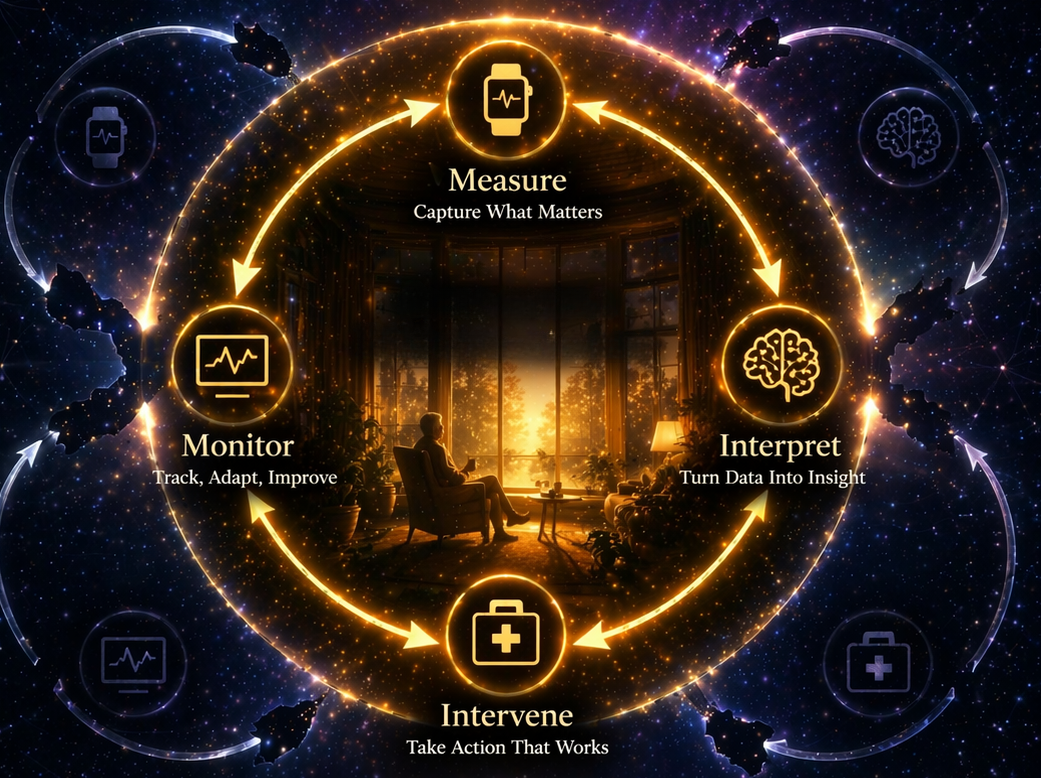
Think about how a thermostat works. It measures the temperature in the room. It interprets that measurement against a target. It intervenes — triggering the heating or cooling system. It monitors the result. Then it measures again. The loop runs continuously. Nobody has to remember to check the temperature. Nobody has to decide whether to act on the reading. The system runs because the environment is designed to run it.
A preventive health system works on exactly the same principle. Not as a metaphor. As a precise description of how it must be built.
Measure
The measurement layer captures signals from the biological environment. Biomarkers from a blood panel. Physiological data from a continuous monitoring device. Cognitive assessment scores. Sleep architecture from a wearable. A blood panel sitting in a portal that nobody has reviewed is not healthcare. It is data.
Interpret
The interpretation layer transforms signals into clinical meaning. What does the combination of declining HRV, elevated homocysteine, and reduced deep sleep percentage mean for this resident’s cognitive risk? Modern interpretation infrastructure is genuinely powerful — but interpretation without connection to intervention is inert. The most precise risk score in the world produces no outcome until it drives action.
Intervene
The intervention layer delivers the actions the interpretation called for. The cognitive health supplement in the morning medication pass. The dietary protocol adjusted based on last week’s CGM data. The sleep protocol triggered by the wearable’s declining deep sleep signal. This is the layer where most preventive health systems break — not at measurement, not at interpretation, but at the point where a recommended action depends on the individual to sustain it consistently. In an assisted living environment, the intervention is delivered by the structure of the environment, not by the individual’s daily decision.
Monitor
The monitoring layer tracks what happened after the intervention. Was the supplement taken? Did the cognitive score improve? Monitoring closes the loop. Without it the system does not learn. When monitoring feeds back into measurement, each cycle becomes slightly more informed than the last. Each protocol more precise. Each outcome better.
FROM SNAPSHOT TO TRAJECTORY
Traditional healthcare operates in snapshots. A lab test captures a moment. The next snapshot is three months away. This is deeply wrong for preventive health, which requires understanding trajectory, not position. Knowing that a resident’s homocysteine was elevated at her last quarterly panel is useful. Knowing that it has been rising consistently for three panels, correlating with declining deep sleep duration in her wearable data, and that her B-vitamin adherence has been below 70% in the six weeks preceding each panel — that is actionable clinical intelligence the snapshot model cannot produce. The loop transforms data from static to dynamic. From description to prediction. From position to trajectory.
WHY INSTITUTIONS —
THE BRIDGE TO WHAT WE BUILT
The loop can run anywhere the environment enforces its transitions. Consumer models cannot enforce them. Apps, subscriptions, and DTC products all depend on the individual to initiate each transition. And the individual eventually stops.
Institutions enforce. The morning medication pass runs 365 days a year regardless of motivation. The EHR governs every clinical workflow. Staff are present when the data arrives and empowered to act on it.
Assisted living is the entry point. It is the environment where the loop runs most cleanly, the population where the clinical need is most acute, and the sector where no one has built this before. The network scales from there.
The 8 Laws of the Preventive Health Economy → 40 published articles.